Q1 2026
Portfolio Website Redesign
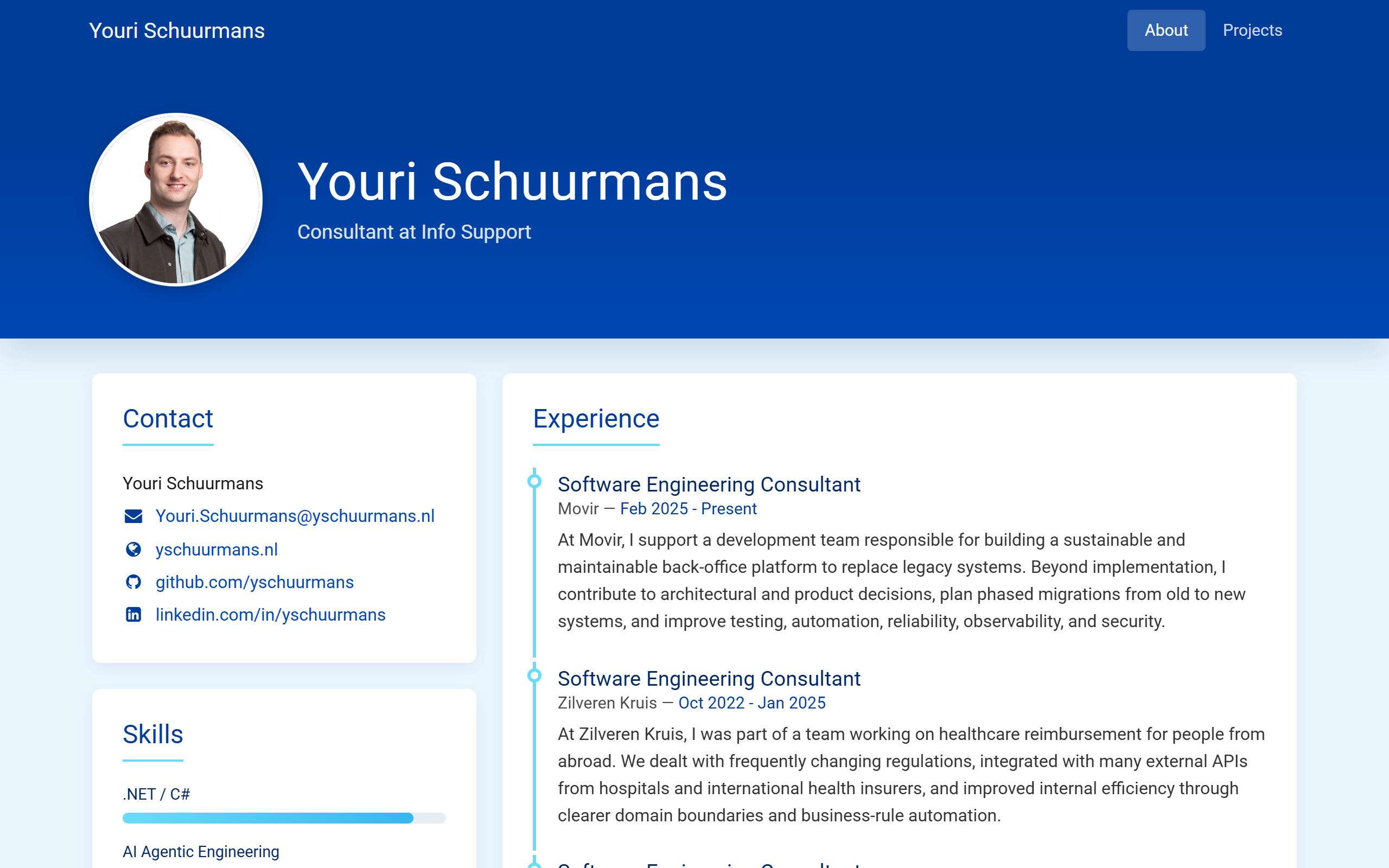
A ground-up rebuild of my original portfolio into a modern, container-friendly Hugo site, guided and accelerated through AI agentic engineering.
Year after year, my original portfolio website started to look, feel, and behave more dated. At the same time, keeping it running became increasingly inconvenient. Hardware upgrades regularly forced me to jump through the same setup hoops again just to get my online identity back in place, and every round of maintenance felt more cumbersome than the last.
The broader ecosystem had also moved on. Running a personal site through IIS and a custom ASP.NET stack no longer felt like the right default for a small portfolio. If I was going to touch the site again, it made more sense to rethink the whole thing from the ground up and move toward an architecture that was easier to host, easier to maintain, and better suited to the job.
For a long time, that redesign stayed on my procrastination list because I knew exactly how much work was hiding behind it. Rebuilding the content model, defining the design language, migrating data, and setting up a cleaner deployment flow would normally take a serious amount of time. That changed in early 2026, when AI agentic engineering started becoming genuinely practical for real development work.
At that point, I decided this was the ideal project to test the limits of the technology on something real that I already understood well. I gathered the original source code, exported the database contents, collected the project media, and started working with Claude Code to figure out the best migration path.
Together, we explored what should be preserved, what should be modernized, and what would make the site easier to maintain in the future. That process led to a concrete set of requirements covering content structure, styling, routing, media handling, and deployment expectations.
Once the plan was clear, I let the implementation run. After watching the agent work for a while, I stepped away to make dinner and expected I would come back to something half-finished, broken, or blocked. Instead, when I returned about an hour later, I found a working project with a setup guide, a modernized design, and most of the important content already migrated into place.
It was not perfect on the first pass. A few parts were still missing, largely because some information had not yet been provided to the agents and because I had intentionally constrained the environment with a security sandbox. Even so, the result was strong enough to prove the concept immediately: AI could meaningfully accelerate a real-world rebuild, as long as the problem was framed well and the human stayed responsible for direction, review, and refinement.
This redesign therefore became more than just a portfolio refresh. It turned into a practical experiment in human-AI collaboration, modern static-site architecture, and the kind of development workflow I expect to use more often going forward.
GitHub Repository: